
Buy a Record, Make a Difference 15: Andre Lachance

Buy a Record, Make a Difference is a new series we have created to help local musicians generate income during COVID-19. It is based on the principle that we should support and reward the hard work local artists have already put into recordings, as it is an immensely difficult undertaking to be creating new material under current circumstances. There is currently a lot of emphasis on livestreaming and innovation in our industry, and while those things absolutely have their place, we think it’s also important to boost projects that have already been completed.

In each post, we’ll ask a local artist a series of the same questions, give them the opportunity to talk about recordings they’re proud of, and ask them to talk about other local musicians whose work they admire. It’s our hope that you’ll take the time to listen to & purchase the work of local artists, or at the very least share their work with others.


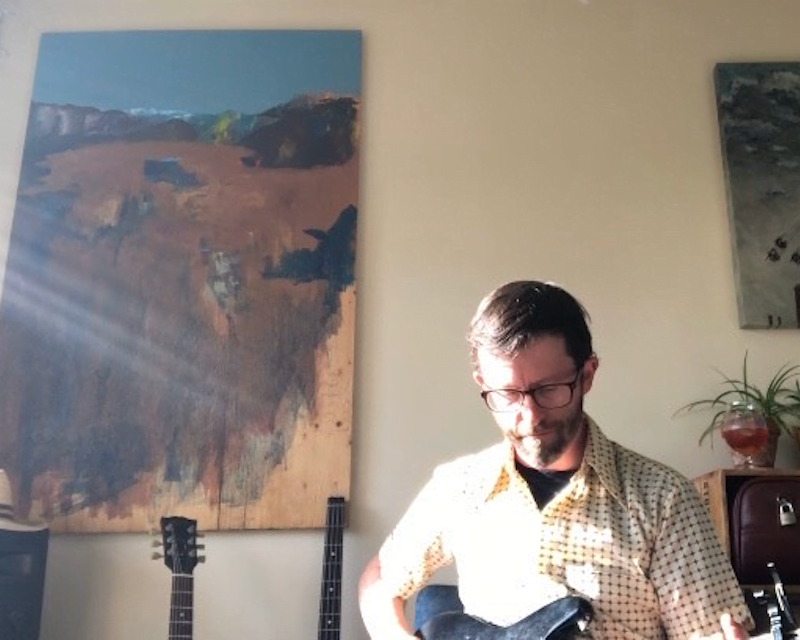
ANDRE LACHANCE

Photo: Vincent Lim
1. Who are you? 

My name is André Lachance. I’m originally from Québec City and have been living here in Vancouver for 30 years. I play, perform and record on double-bass, electric bass and guitar. I also teach lessons and workshops, compose, watch hockey, ride my bike and enjoy supporting the small businesses in my neighbourhood. Also I like dogs.

Over the years, I have been a part of Vancouver-based ensembles the Peggy Lee Group, Brad Turner Quartet, Hard Rubber Orchestra, Chris Gestrin Trio, Kevin Elaschuk’s groups, Oddity and many more. I’ve also been blessed to perform with visiting international artists Lee Konitz, Clark Terry, Kenny Wheeler, Benny Golson, Joe Lovano, Kenny Werner, Gary Bartz, Roy McCurdy and many others. 

2. Describe your music as best you can.

As far as my own music is concerned, I’ve lead a group on guitar for the last 10 years (most often the group leads me..) that performs my original tunes, Quatuor Andre Lachance. It’s a mix of jazz, prog rock, weird sounds and pretty sounds, with a broad range of compositional influences and with vintage synth bass, like the old Stevie Wonder records. Brad Turner, Chris Gestrin, Joe Poole are in this group and we released an album in 2017 called “The Orange Challenge” and are slowly working towards another. On double bass, I often play in a horn(s)/bass/drums format and have a current project with Joe Poole, Jon Bentley and Brad Turner that was scheduled to perform in the 2020 Vancouver Jazz Fest. 

3. What’s your latest recording (or a recording you’d like to promote)? Where can people get it?

The latest one that just came out this spring is a live recording with the Brad Turner Quartet plus the fantastic Seamus Blake that was recorded at Frankie’s a little over a year ago. 

4. Is there another local musician whose work you’d like to give a shout out to? 

I’d like to nominate Jeff Younger. Aside from being an all around awesome dude and great and eclectic musician and composer, he has also done a lot over the years to help foster the scene, whether by carrying on with various music projects but also the important work of helping to run and manage small DIY music venues, to give us places to play and hang and enjoy listening to creative groups.

Buy a Record, Make a Difference 14: Julia Ulehla

Buy a Record, Make a Difference is a new series we have created to help local musicians generate income during COVID-19. It is based on the principle that we should support and reward the hard work local artists have already put into recordings, as it is an immensely difficult undertaking to be creating new material under current circumstances. There is currently a lot of emphasis on livestreaming and innovation in our industry, and while those things absolutely have their place, we think it’s also important to boost projects that have already been completed.

In each post, we’ll ask a local artist a series of the same questions, give them the opportunity to talk about recordings they’re proud of, and ask them to talk about other local musicians whose work they admire. It’s our hope that you’ll take the time to listen to & purchase the work of local artists, or at the very least share their work with others.


JULIA ULEHLA

Photo: Emma Joelle
1. Who are you? 

I am a vocalist, composer/devisor, and soon-to-be Dr. Ethnomusicologist based in Vancouver, with former lives as an opera singer and laboratory theatre actress. I’m a mother of two young girls, and I try to find ways to coherently integrate creative life, research life, and domestic life.

2. Describe your music as best you can.

As an artist, I am probably most interested in the many expressions of vitality and life force behind music and sound. I try to hone my craft so that as many of those expressions as possible might manifest through me. I would say that I am an improviser, but my practice doesn’t involve improvising over chord changes, or exploring vocal effects and extended technique. Although I worked as an opera singer for several years, the place where I really learned how to sing was a laboratory theatre hidden in a village in Tuscany—it’s called the Workcenter of Jerzy Grotowski and Thomas Richards—where I was a resident actress for about five years. Of all the art-making I have seen in my life, the performance work that is done there is among the most profound I have witnessed. It was more like a mystery school or a monastery than a theatre. My colleagues and I sang the same melodies for hours a day, 6 days a week, 48 weeks a year, year after year. The practice asked that you recognize your own banalities and habits, and realize when you are just going through the motions. Eventually, for me at least, it engendered the desire to sing with all that I had, without hiding—almost like a sacred act. It helped me to become attuned to following a song and giving it agency to do what I could never come up with on my own. The practice could be described as a kind of deep receptivity—to song, collaborators, audience, room, time of day, year, what else? What does a song need, at any given moment, to be alive? As the band members of Dálava know (Dálava is one of my main projects), while we always make a set list, it usually goes out the window after the first or second song, as the life of the thing takes the reins. Even though we may play the same songs, they are never the same way twice—what can manifest as tender and delicate one night, might manifest as raw and trashy the next. Maybe for me performance is a little bit more akin to ritual, or catharsis, or as a vehicle for communitas, than as a spectacle, or entertainment, or display of virtuosity. And, lest I get carried away, singing and song are also just an extremely basic element of existence, like breathing. Some of my earliest memories are of my mother singing, and as I raise my girls, song is bouncing off walls and corners everywhere in our house—silly, somber, wild, elegant. 

3. What’s your latest recording (or a recording you’d like to promote)? Where can people get it?

The last Dálava record, The Book of Transfigurations, came out in 2017. You can get it here. We were supposed to record another album this June, and I had planned to debut two new works at the Monheim Triennale in Germany this summer, but then corona came around! My husband Aram Bajakian and I recently did a collaboration with Martin Shaw, the wonderful British mythologist/author/storyteller, in which we scored one of his original stories about a shape-shifting goddess who tries to reignite her love with Manannán mac Lir, the Irish god of the sea. Martin’s language is so rich and wild-ish, and as he describes the sound world, “it’s like being at midnight mass in some snowy Carpathian chapel filled with mermaids, Welsh poets and the Baal Shem Tov.” But wait—alongside promoting those recordings, let me suggest another form of sound that people might engage with. Quarantine offers new avenues for domestic creativity. It is a great time for songs and stories at home—no matter who you live with. I sometimes think to myself—what would these months look like if people started making music in their own homes, playing and experimenting? I have found that song heritage is a powerful creative catalyst (much of my work involves reanimating a song tradition that quasi-died when my dad emigrated to North America from Czechoslovakia). For me there has been so much to discover in the old songs of my heritage, and they are remarkably relevant to the times we are in. So yes, please buy music. But also, try making your own music! Sing a song your grandma sang! Go check out an online folk song archive and figure out what people sang in the part of the world that your people come from—if you don’t already know.

4. Is there another local musician whose work you’d like to give a shout out to? 

I love Vancouver’s creative music scene, and as these blogs attest, creators are busy creating! Many of my favorites in the creative music scene have been mentioned by other artists, so I am going to give a shout out to I Putu Gede Sukaryana (also known as Balot). Balot is a gamelan musician here in Vancouver for a few years as he gets a degree at UBC and leads the gamelan. Although he is steeped in Balinese gamelan, he is a masterful percussionist, innovative composer, and vibrant performer who has been getting sucked into the orbit of the creative and improvised music scene here more and more, in part because of his wide open mind. I admire his huge, joyful spirit and generous musicality. He and I have been working on a duo that we were going to do at Jazz Fest, in which we made a spatialized sound structure that is “efficacious” for both of us—coming from two very different musical cultures. Check out his labor-of-love Insitu Recordings (with Jonathan Adams); it is well worth diving into!

Buy a Record, Make a Difference 13: Stephen Lyons

Buy a Record, Make a Difference is a new series we have created to help local musicians generate income during COVID-19. It is based on the principle that we should support and reward the hard work local artists have already put into recordings, as it is an immensely difficult undertaking to be creating new material under current circumstances. There is currently a lot of emphasis on livestreaming and innovation in our industry, and while those things absolutely have their place, we think it’s also important to boost projects that have already been completed.

In each post, we’ll ask a local artist a series of the same questions, give them the opportunity to talk about recordings they’re proud of, and ask them to talk about other local musicians whose work they admire. It’s our hope that you’ll take the time to listen to & purchase the work of local artists, or at the very least share their work with others.


STEPHEN LYONS

1. Who are you? 

I’ve been playing guitar and writing music that ranges from irritating to intriguing since I was too young to realize how irritating some of it was, a fact I now find intriguing. I’ve led the 7-piece Fond of Tigers like an embattled substitute teacher since around 2004. After winning a JUNO in 2011, we’ve mostly spent our time shaving chips off the crystal statuettes to create bespoke jewelry, but also found the time to release our fourth album Uninhabit on vinyl in 2017 (after it leaked to the internet in late-2016). A few years back, myself and two other Tigers (Shanto Acharia and Skye Brooks) started the breakaway faction Limbs of the Stars. In a sternly worded open letter to the local papers, the other four Fond of Tigers members disavowed our practices, which they referred to a “dark, and anti-Tigerean”. To be fair, Limbs’ rehearsal sessions are lit so lowly you can’t read sheet music of any kind, and we’re constantly knocking over our drinks by accident.

I also play in various other projects, some of which have come out under the Offseason Records umbrella (www.offseasonrecords.com). There are also a few things coming out in the next while that I played drums on, including new music from Parkland, a band that’s a bit like what you’d get if an alt-country songwriter swapped his backing band’s light beers for genuine Czech absinthe, and Rick Maddocks’ ambitious and populous Songs from the Black Sand, inspired by the climate emergency and spaghetti-western soundtracks, featuring about 14 of Vancouver’s finest roots, jazz, classical, and ‘other’ musicians. 

2. Describe your music as best you can.

Like me as a person, the music is a bit all over the place. Fond of Tigers seems to have come out of the oven tasting like a mix of post-rock, noise, 20th century minimalism, and avant-jazz, despite my main influential ingredients being 80s hip hop and 70s country music. It’s like an isolation sourdough loaf gone terribly wrong, but that somehow still tastes good—or at least interesting—to a few people, depending on what kind of dips and spreads are available. 

Limbs of the Stars is more of a Russian rye bread, I’d say. Darker. More of a slow chew. Just a hint of malty sweetness. Our forthcoming album, which is about half finished, features some very understated, vocal-based songs as well as expansive, moody instrumentals. “Cheer up, for god’s sake!” said one local radio personality, who I won’t name here, mainly because his parents beat me to it over half a century ago.

During this time of lockdown, I’ve been writing a bunch of music in an alternate tuning I arrived at somewhat by accident, and I’ve ardently applied myself to making it as happy an accident as possible. I do that sort of thing now and again, putting up obstacles or challenges once I start getting comfortable. It seems to help me to engage in the writing process and not fall back on more well-worn neural pathways.

3. What’s your latest recording (or a recording you’d like to promote)? Where can people get it?

The most recent Fond of Tigers album is Uninhabit, available here. It takes digital form as well as 180-gram vinyl and CDs, in preparation for the coming compact disc renaissance. 

Limbs of the Stars were slated to play this year’s fest. We’ll have some new material coming out fairly soon (featuring pedal steel player Paul Rigby), but the previous releases can be found here.

Our 2012 debut “heartwarmongering” is more of a song-based album, while 2018’s “Somewhere, BC” is a long form electric guitar and cello piece initially created as part of an art installation of the same name featuring fog-cloaked, west coast-centric visual works by Wallace Barber. 

Recordings from other bands I’ve been in, including Sun Belt, French for Sled Dogs, Cloudsplitter, Boks & Branches, etc can be found via the Offseason website.

4. Is there another local musician whose work you’d like to give a shout out to? 

When I first started going to jazz fest shows, some of my favourites were local artists who were a bit older than me, and very active in the rising creative music scene, playing throughout the year at 1067 and the Sugar Refinery, and then stepping up to an even higher level for some of the fest shows. It would be a good idea for anyone who likes good music, or is considering starting to like good music, to check out recordings featuring Peggy Lee, Dylan van der Schyff, Ron Samworth, Tony Wilson, and others who helped define the Vancouver creative music scene and who continue to evolve and innovate.